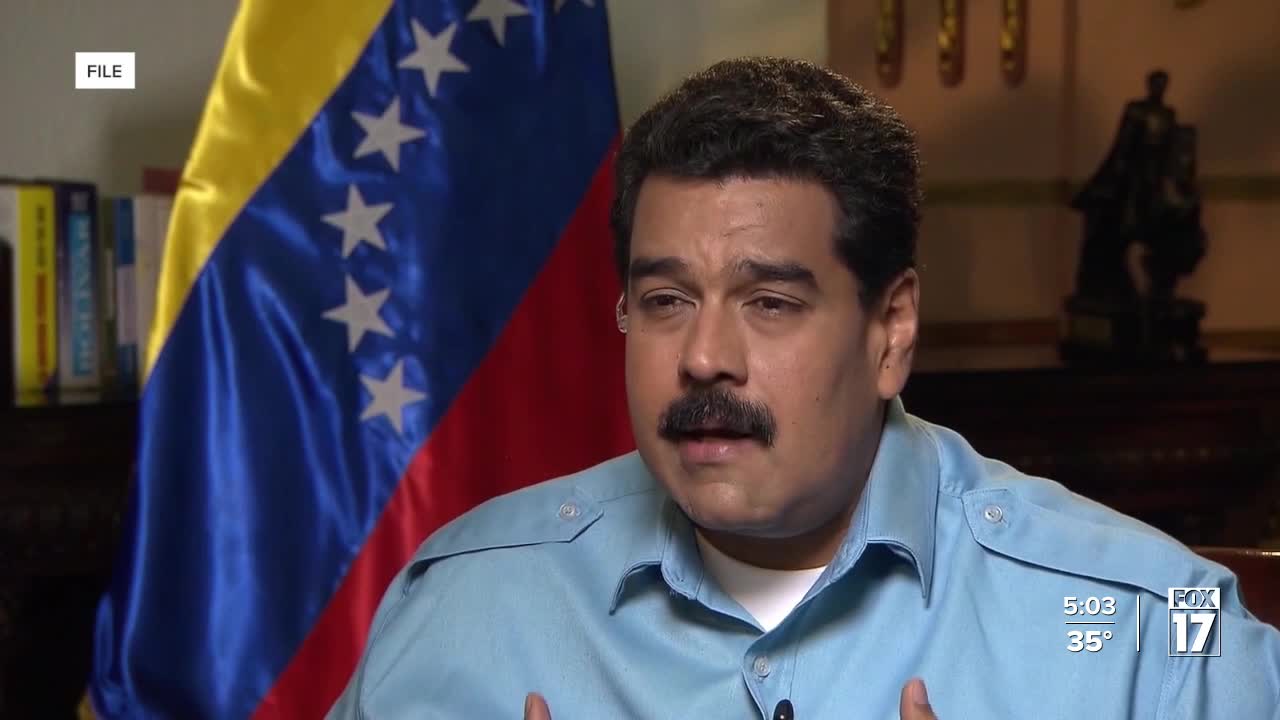


GRAND RAPIDS, Mich. — A group of West Michigan neighbors from Venezuela penned an open letter following last weekend's arrest of Nicolás Maduro, expressing happiness about the regime change and hope for their native country's healing.
"When my brother called me, I cried. And then I was so happy," Maria Virginia Morin said.
Morin remembers her brother calling early Saturday morning. Born in Venezuela and now living in Grand Rapids, she says she still has family there.
"When Maduro was extracted, he heard all the bombing in his apartment, he was able to see the bombs that fell," Morin said.
Morin explains a lot has changed since she lived in Venezuela.
"Health-wise, it's down the drain. Education is down the drain," Morin said.
She puts considerable blame on President Nicolás Maduro.
"I thank President Trump and his administration for doing it. He needed to be extracted. Like we say, it's like a cancer that you have to go in and just take him out," Morin said.
Morin and her friend Jose Duran, another Venezuelan living in West Michigan, penned the letter.
Letter to American Friends About Venezuela
Many of our friends in the United States lack the full context of what the Venezuelan people have endured over the past 27 years. That is why we write—not from a political ideology, but from a deeply painful human experience.
Since 1999, with Hugo Chávez’s rise to power, Venezuela began a process that concentrated power in the government, weakened democratic institutions, and progressively silenced dissenting voices. Today, there are more than 900 political prisoners. What began with promises of social justice ended in the destruction of democracy, the loss of fundamental freedoms, and the collapse of the country. Parts of the military high command (known as the Cartel of the Suns) and the government became involved in corruption and drug trafficking networks that have affected—and continue to affect—not only Venezuela, but also other countries, including the United States and Europe.
Under Nicolás Maduro’s regime, this reality worsened. Venezuela has endured hyperinflation, extreme shortages of food and medicine, hospitals without basic supplies, constant power outages, lack of potable water, and wages that are not enough to survive. Millions of families were forced to choose between eating and buying medicine. This is not an exaggeration or a political narrative; it is the daily reality that many Venezuelans lived—and still live.
Furthermore, expressing a different opinion became dangerous. People have been imprisoned for protesting, for posting messages on social media, or even for sending a critical WhatsApp message about the government. Elections are manipulated, political persecution is widespread, and there is a constant fear of speaking the truth. As a result, more than eight million Venezuelans have fled the country—not in search of “better opportunities,” but escaping an unsustainable reality.
Nicolás Maduro is not an elected president. He ignored the results of the presidential election on July 28, 2024. He took it by force. But there is an internationally recognized, democratically elected government under the leadership of Edmundo Gonzalez (President) and Maria Corina Machado (Vice President, because she was barred from running), which has a full plan ready to transition into the ruling government.
There is also a dimension many Americans are unaware of: Venezuela is no longer just an internal crisis. The country has been progressively infiltrated and controlled by foreign interests and irregular groups. Cuban advisors and intelligence structures have exerted strong influence over political and social control. At the same time, China and Russia have gained strategic access to natural resources such as oil and minerals, compromising national sovereignty.
In addition, there are serious allegations and international reports regarding the presence and protection of armed groups and organizations designated as terrorist, such as the ELN, FARC, Hezbollah, and networks linked to Hamas. This represents not only a threat to Venezuelans, but also a direct concern for regional security and for the United States. Venezuela has become a territory used by actors hostile to democratic Western values. For this reason, when many Venezuelans express relief, hope, and even joy at the capture of Nicolás Maduro, it is important to understand why. This is not about revenge or hatred. It is the natural reaction of a people who have suffered decades of abuse, corruption, repression, and loss of sovereignty. For many, this moment symbolizes the beginning of justice, the end of an era of oppression, and a real possibility to rebuild the country with dignity and freedom.
Celebrating the end of an authoritarian leader does not mean ignoring the pain that remains or the enormous challenges ahead. Venezuela will require deep structural change, collective healing, reconciliation, and reconstruction. But for those who have lived this suffering firsthand, this moment represents hope after many years of darkness.
We ask something simple of our American friends: listen to Venezuelans. Before judging, comparing it to local politics, or reducing it to ideological debates, remember that this is not theory. This is real hunger, real fear, real exile, and real lives.
This is not a partisan issue.
It is an issue of human dignity.
José Durán & Venezuelans in West Michigan
"It's the first step to bring freedom to our country. So (I) would say that, but I understand there's some issues the legality that it was done, but we don't want to talk about that, because that is not our issues right now. Our issue is Venezuela," Duran said.
Questions remain about what's next for their home country. The two say they support U.S. involvement for "the security and the stability of Venezuela," Morin said.
But they don't want the U.S. to overstay.
"It will be too much that Venezuela became the 51 states of the US," Duran said.
This story was reported on-air by a journalist and has been converted to this platform with the assistance of AI. Our editorial team verifies all reporting on all platforms for fairness and accuracy.

